Lisping and Unclear Speech in Children: Articulation and Phonological Therapy Guide in Pendik
Understand speech clarity milestones, why kids confuse R, S, or K sounds, phonological delay, and speech therapy interventions at Önce Özel Eğitim in Pendik.
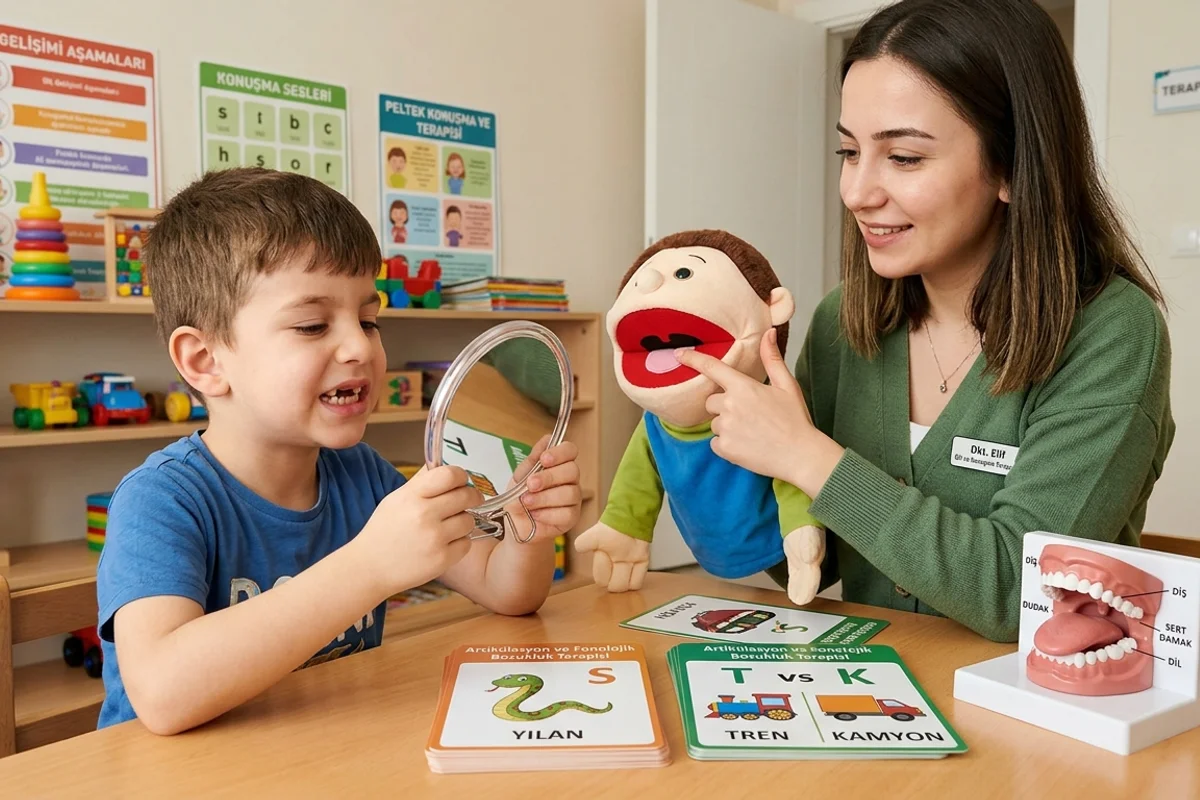
"We understand everything our child says at home, but on the playground, peers and teachers cannot understand a word...", "People told us they would outgrow it, but school is starting and they still can't say R or S sounds..." Many parents initially view childish mispronunciations as cute habits. However, as preschool ends and primary school approaches, persistent speech sound errors can undermine self-esteem, leading to social hesitation, fear of speaking in class, and eventual reading-writing difficulties (dysgraphia).
At Önce Özel Eğitim Speech and Language Therapy Center in Pendik, Istanbul, our licensed Speech-Language Pathologists (SLPs) believe in the transformative power of early intervention. In this clinical guide, we explore the critical differences between lisping, sound omission, articulation disorders, and phonological delays, alongside proven therapeutic strategies.
Articulation vs. Phonological Disorders: What is the Difference?
While both conditions reduce speech clarity, their underlying neurological and physiological roots differ significantly:
1. Articulation Disorders (Motor Execution Deficit)
An articulation disorder involves physical difficulty placing speech articulators (tongue, lips, teeth, palate, and jaw) in the correct positions to produce specific sounds. Common patterns include:
- Sound Substitution: Replacing a challenging sound with an easier one (e.g., saying "wabbit" instead of "rabbit", or "tup" instead of "cup").
- Lisping (Interdental Sigmatism): Protruding the tongue tip between the incisors when articulating S and Z, causing air to escape inaccurately.
- Sound Deletion (Omission): Dropping sounds from words (e.g., saying "ca" instead of "cat").
- Sound Distortion: Producing slushy, nasal, or lateralized sound variations.
2. Phonological Disorders (Cognitive-Linguistic Rule Deficit)
In phonological disorders, the child can pronounce the sound in isolation without difficulty, but their brain has not organized the language rules regarding how sounds fit together in words. For example, a child who can easily produce a standalone "K" sound might systematically delete it in conversational words, saying "at" for "cat".
Speech Sound Developmental Milestones: What Should Emerge When?
Different speech sounds require varying degrees of neurological and motor maturation. It is entirely age-appropriate for a 3-year-old to struggle with "R", but struggling with "K", "T", or "P" at age 4 warrants clinical evaluation:
- Ages 2 to 3: Early consonants emerge (B, P, M, D, T, N). Speech should be 50% to 75% intelligible to family members.
- Ages 3 to 4: K, G, F, V, and H sounds stabilize. Strangers should understand at least 75% of what the child says.
- Ages 4 to 5: Complex sounds (S, Z, SH, CH, J, and L) develop. Speech should be almost completely intelligible (90%+) to unfamiliar listeners.
- Ages 5 to 6: The highly demanding motor-intensive R sound and consonant clusters (such as "bl", "tr", "st") achieve mastery.
What Causes Speech Sound Disorders in Children?
- Anatomical & Structural Factors: Tongue-tie (short lingual frenulum), high arched palate, malocclusion (dental alignment issues), or cleft palate.
- Recurrent Ear Infections (Otitis Media with Effusion): Frequent fluid accumulation in the middle ear during infancy creates muffled hearing, causing the brain to encode acoustic models incorrectly.
- Oral-Motor Weakness: Reduced muscle tone or poor coordination in lifting the tongue tip or rounding the lips.
- Reinforcing "Baby Talk": Family members inadvertently imitating or praising incorrect speech patterns rather than providing clear adult models.
How Pediatric Speech Therapy is Conducted
At Önce Özel Eğitim, certified speech pathologists design individualized, game-based therapy sessions:
- Sound Isolation: Using mirror biofeedback and tactile cues so the child learns where to place their tongue and lips for the isolated sound (e.g., the snake sound for "S" or motor sound for "R").
- Syllable & Word Progression: Moving from nonsense syllables ("Sa, Se, Si") to initial ("Sun"), medial ("Basket"), and final word positions ("Bus").
- Phrase & Conversational Generalization: Transitioning newly mastered sounds into spontaneous dialogue, storytelling, and social games.
Pediatric Speech Clinic in Pendik: Easy Access from Kartal, Tuzla & Gebze
Left unaddressed, speech sound delays frequently transfer into reading and writing difficulties in school. Located in central Pendik within walking distance of the E-5 Highway and Marmaray train station, our modern clinic is easily accessible for families from Kartal, Maltepe, Tuzla, Kurtköy, and Gebze.
Empower your child to speak with clarity and confidence. Contact Önce Özel Eğitim today to schedule a free initial speech and language screening.
Consult for Your Child's Development
Let us evaluate your child's developmental needs free of charge with our expert instructors and psychologists. You can contact us for any questions.
Consult via WhatsApp